Dear friends and comrades
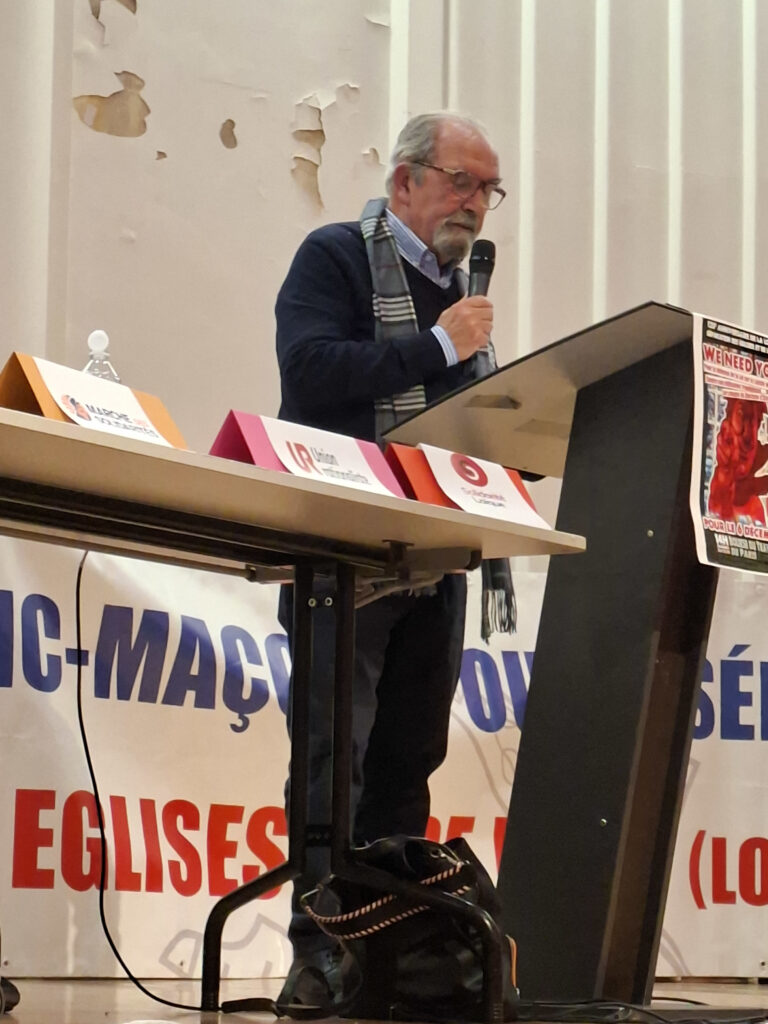 It is with great pride that I am here today to commemorate the 120th anniversary of the law separating Church and State in France, a law which, fifty years ago, was a beacon of enormous importance in helping to enshrine this same principle in the Portuguese Constitution of 1975, along with freedom of conscience.
This came after a dictatorship that lasted more than 48 years and in which the Catholic Church played a major role. The dictatorship had just collapsed following a military coup, and young people and workers seized the opportunity to take to the streets and dismantle the old institutions of the former regime.
At the same time, they replaced them with new organisations such as workers’ committees in companies, tenants’ committees in neighbourhoods, users’ committees in hospitals and also in schools and universities, teachers’ and students’ committees. In the south of the country, agricultural workers occupied and confiscated the land of large landowners, paving the way for genuine agrarian reform.
At the heart of this process of revolutionary mobilisation was the end of a colonial war that had lasted fourteen years and left thousands dead, maimed and traumatised on both sides of the barricade.
My active and direct participation in the ongoing revolutionary process led to my election as a member of the Constituent Assembly and to the inclusion in the Portuguese Constitution of the main social and democratic achievements of the April Revolution, including: – the right to health care as a universal and free right; the right to education, housing and social security; the right to strike as an inalienable right; the right to freely form trade unions and workers’ committees;
And that is why I am very proud to be here, thanking the organisers of this international initiative in defence of secularism, at a time when all these achievements are being challenged by a right-wing Portuguese government, subordinate to the war policy of American imperialism and its military institutions, such as NATO.
And as we can all see from the various speeches that have already been made, coming from different backgrounds, we are witnessing a generalised offensive, using the pretext of migration, with truly xenophobic campaigns, aimed in reality at dismantling the working class as an organised class.
But we are also witnessing widespread resistance to this offensive, which is taking the form of demonstrations of solidarity with the Palestinian people, bringing millions of people onto the streets in every corner of the world, and international initiatives such as the one on 5 October in Paris, ‘Not a penny, not a weapon, not a life for war”, which brought together delegates from 19 countries, including a Portuguese delegation.
It is this international coordination that must be continued and pursued, which is why this meeting is so important.
In conclusion, I would like to inform you that the resistance will continue in Portugal.
Preparations are underway for a general strike on 11 December, called for the first time in eleven years by the two trade union confederations, the CGTP and the UGT, against the “labour counter-reform” law, which is a real lever for dismantling the labour rights of Portuguese workers, in particular the right to strike in its entirety.
Down with xenophobia! Long live secularism!
Long live the global working class!